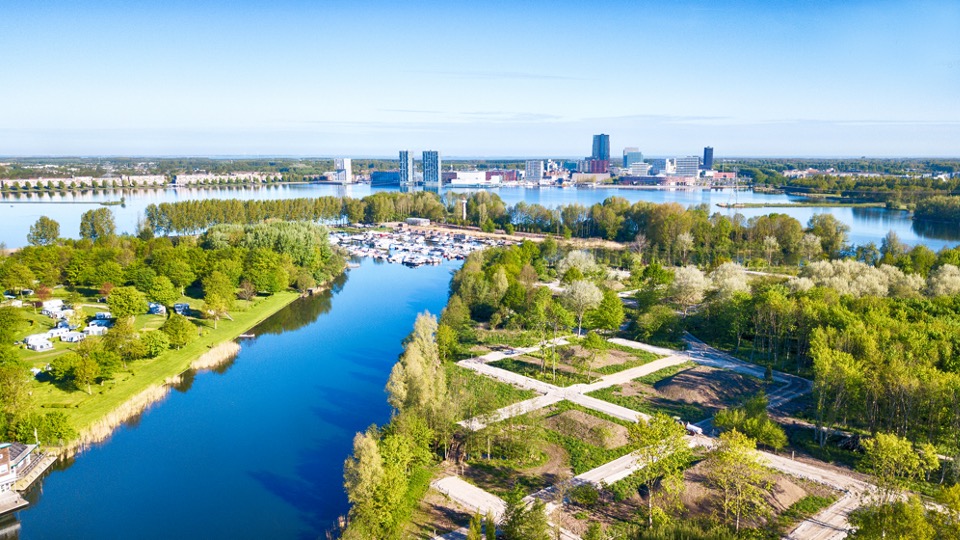
Almere is considered the most successful New Town in the Netherlands. The city is only a few decades old, boasts over 200,000 inhabitants and is still growing as part of the Amsterdam Metropolitan Area. Building upon its garden city-inspired development patterns, the municipality is capitalising on the Floriade 2022 horticultural expo it will soon be hosting to explore what “growing green cities” can look like.
Located in the Flevoland Polder, Almere was created to supply housing for the urban expansion of Amsterdam and the Randstad area in the 1970s. The goal was to prevent existing cities to expand, so as to preserve the “Green Heart”, a large green and nature area within the Randstad circle.
The initial master plan for Almere drew inspiration from the Garden City Concept, developed by the English sociologist Sir Ebenezer Howard. This revolutionary model for development created in 1898 assumes a harmonious relationship between city and countryside. The city of Almere was therefore designed as a number of semi-separate nuclei, each with its own neighbourhoods, facilities and identity, connected through shared infrastructure and a common city centre. These districts are separated by stretches of water and extensive green areas (parks, woodlands, agricultural land). According to the University of Wageningen’s Municipal Greenspace Benchmark, Almere has over 100% more green space per inhabitants than other Dutch cities of a similar size. Another striking feature is the system of separate traffic flows – with separated bicycle paths and bus lanes.
30 years after first residents started to move in (1976), Almere became yet again the focus point for solving housing problems for the growing population of the Randstad as well as offering space for businesses. In 2006, the Dutch Government set the target for Almere to double its population by 2030. With a new expansion that would add up to 60,000 new dwellings and 100,000 new jobs, the city faced new challenges, which required visionary strategic planning once again.
There was a debate regarding how best to shape this new phase of growth so as to position Almere more prominently amongst the Netherlands’ main cities. Should a more traditional, continuous built form be preferred to the garden city approach? “Almere wanted to play with the big kids, and the City Council wasn’t sure it could do so if it remained designed as a collection of villages enshrined in a ‘countryside-like’ setting” explains Ria van Dijk, Senior Urban Planner at the Municipality of Almere. In the end, it was found that Almere’s landscape-rich development patterns remained a key asset for its growth, providing an abundance of space and opportunities for contact with nature which many contemporary city dwellers crave. “Almere is located next to two of the largest cities in The Netherlands: Amsterdam and Utrecht; together with Rotterdam and The Hague, they make the country’s four big cities, which have been the main cities in the Netherlands for as long as we can remember”, further explains Ria van Dijk. “We cannot compete in facilities with them, but we can compete with an abundance of green surroundings. For example: there is only market for one opera house in the Netherlands, maybe two. It would make no sense to also want to have one in Almere… So for (cultural) facilities, we cannot make a difference in number or amount, but we can make a difference in quality and surroundings. Our cultural facilities make use of the green surroundings: we have two theatre companies which have their main stage in the green-blue settings of Almere. Vis a Vis for example is located near the beach of Almere Poort. Its open air stage is surrounded by water and woodlands, which gives it a very unique atmosphere”.
The Covid-19 pandemic has further reinforced this shift: what used to be perceived as dull in comparison with city centre living has now become highly desirable. Along with this shift in perception has also come the interest of making Almere’s extensive green space (largely dominated by simple grass areas) more productive for those living nearby. Almere’s extensive grass areas are largely the by-product of the systematic separation of different traffic flows. Contemporary design now favours the co-location of bike paths, bus lanes and traffic lanes open to cars in one single mobility corridor, so as to generate less “left-over” space in the public realm.
The municipality hired the architecture firm MVRDV to develop Almere 2.0, a vision for Almere’s extension. Released in 2009, this plan consists of a loose framework for growth structured around four major development areas, each with their own character, logic and identity: Almere IJ-land, a new island off the coast in the IJ-lake, Almere Pampus, a neighbourhood focused on the lake and open to experimental housing, Almere Centre, an extended city centre surrounding the central lake, and Oosterwold, an area devoted to more rural and organic urbanism. This framework remains true to the garden city ethos, with a strong commitment to maintaining distinct districts separated from each other by green and blue spaces. It also incorporates the idea of ensuring these green spaces provide a range of benefits. This approach was translated in zoning terms, with housing and business developments not allowed within the areas designated as part of the “green and blue structure”, unless it can be demonstrated that such developments can add to its ecological or amenity value.
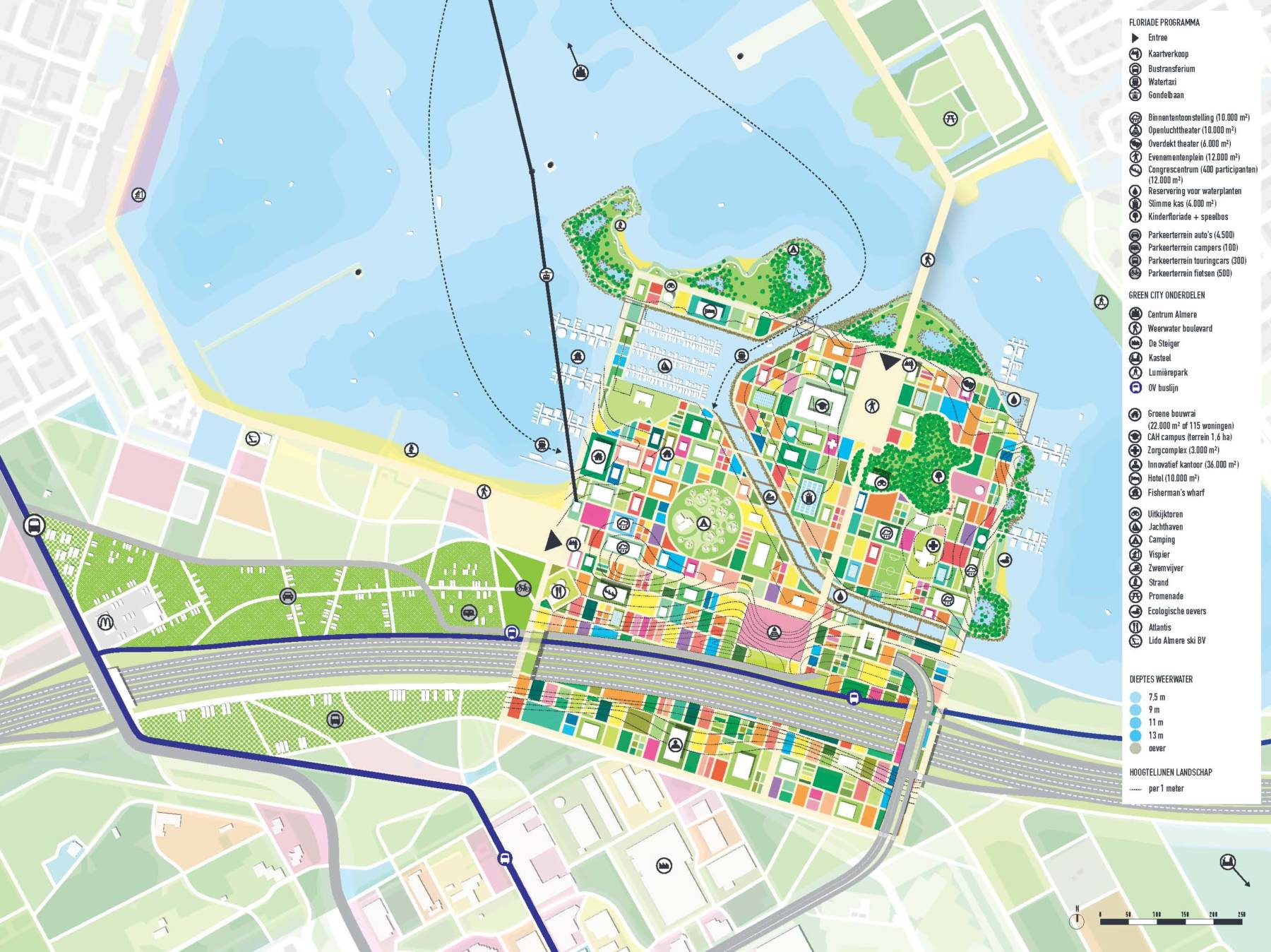
Almere also worked with MVRDV to develop a proposal to host Floriade 2022, the World Horticultural Expo – a bid that proved successful with The Nederlandse Tuinbouwraad (NTR), the Floriade 2022 organising body, and which gained approval of AIPH. The MVRDV plan for Almere’s Floriade 2022 is therefore not a temporary expo site but a blueprint and set of principles for a green extension of Almere’s existing city centre to be developed from the hosting site.
Almere Floriade 2022 is set to take place on a square shaped 64-hectare peninsula located along the lake, across from Almere’s existing city centre, within a vast area that belonged to Almere’s designated network of green and blue space. Due to its extensive size, and its proximity to both the city centre and the A6 motorway, the site had previously been earmarked as a potential location for a green development. “The Floriade 2022 provided a great opportunity to deliver an extra green city development in this location, in that way justifying building in the green-blue network” explains Ria van Dijk. The masterplan aims for the expo and the legacy city centre extension to showcase an exemplar integration of plants and ecological principles with dense development – thereby illustrations the Floriade 2022’s theme of “growing green cities”.